



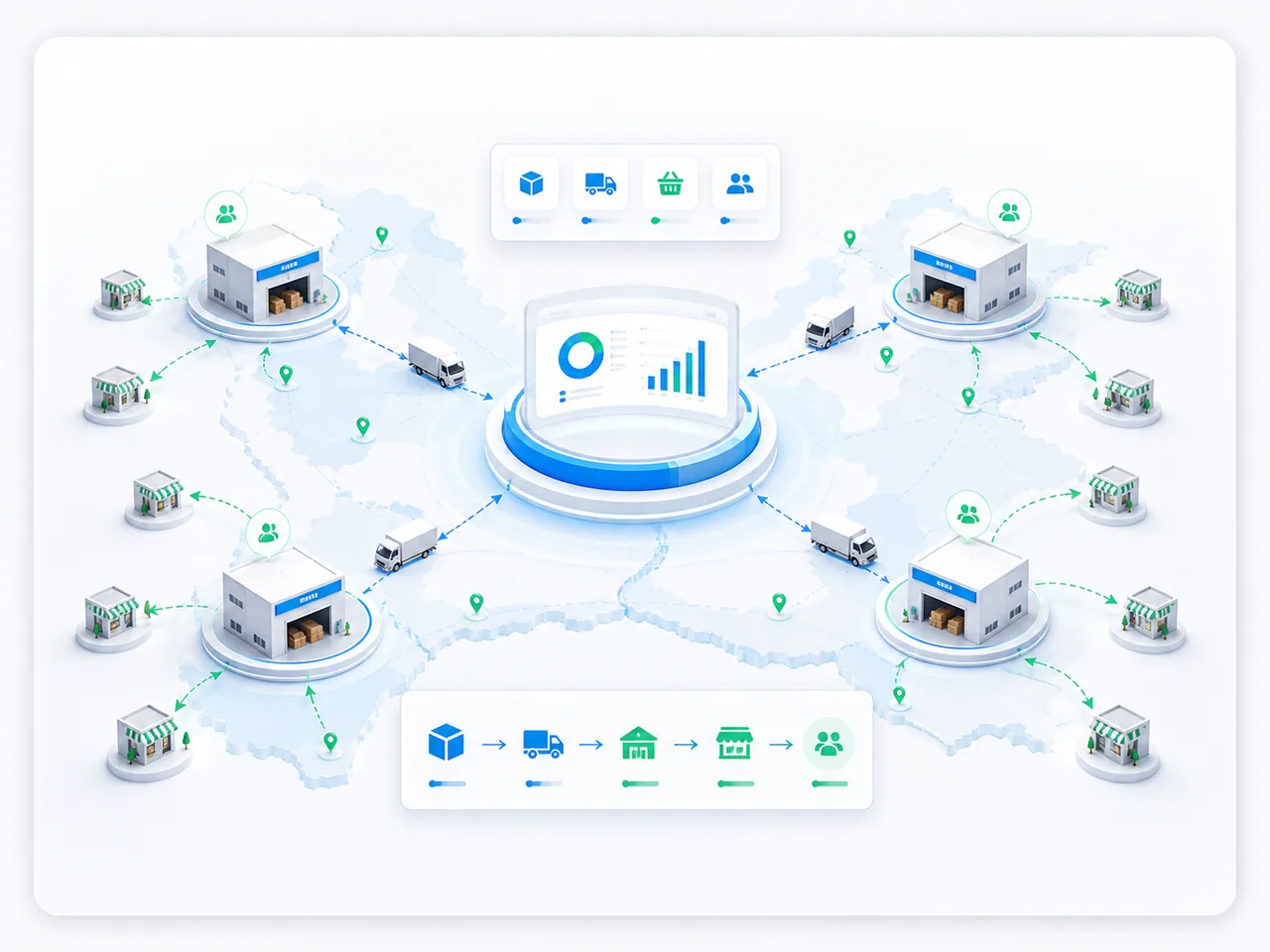
Uzbekistan
- Partner model
- Owned branches and independent distributors
- Data exchange
- Agreed sales, stock and payment facts are exchanged on the defined schedule
- Tashkent
- Samarkand
- Fergana
DMS · NETWORK MANAGEMENT
For distributors, manufacturers and distribution groups. Compare branch and partner sales, stock and receivables to plan replenishment and investigate exceptions down to an outlet and product. Sources and access are agreed with each company.

Multi-entity distribution management
Demonstration model. Geography, sources and access rules are configured for the agreed project scope.
From group to outlet
Which markets and portfolios need a leadership decision?
Closed-loop DMS execution
The manufacturer's shipment is linked to the distributor, warehouse, portfolio and agreed commercial terms.
Data quality and ownership
Duplicate names and addresses prevent sales from separate portfolios being matched to one outlet.
One model, different management decisions
Product and data boundary
For the network decision
DMS helps a distributor manage its branches and a manufacturer or group compare agreed network data. Define the data owner for the group or company, each branch and each independent distributor. Agree access rights and the decision the data must support before connection.
No. Agree the master data and documents needed for the project, along with access rights, exchange frequency and responsibility for quality.
Replacing the accounting system is not required to connect DMS. You can agree data exchange with an existing ERP or define a separate accounting scope in the Smartup ERP core. DMS itself manages the network model and data matching; source ownership and responsibility for corrections remain explicit.
Set matching rules and a master-data owner before management reporting. Unresolved matches belong in a review queue, not an automatic merge.
Platform scale
Shared master data connects sales, stock and settlements. The figures below describe platform scale, not the effect of a DMS rollout. The IBT case covers the related field workflow: visits and shelf recognition.
active mid-sized and large companies in Central Asia
daily active users
confirmed integrations
Start with one branch or partner and a decision: reconcile sales and stock, plan replenishment or investigate receivables.
Participants and systems
Who is involved, which warehouses and portfolios belong in the first stage, and where sales and accounting records are held.
Data for one period
An anonymised sample of sales, stock and relevant documents. Identify the source, refresh time and person authorised to share the data.
Decision and acceptance
Which exception needs investigation, who owns the action and what result will demonstrate that the first scenario works.
If exports are not ready, bring a process outline and a list of systems. Connection feasibility and exchange scope are checked for each participant.
Tell us about one branch or partner, its systems and the decision you need to make. We will clarify available data, exchange scope and acceptance criteria. Timing and cost are assessed once the scope is clear.